SHINRYO CORPORATION (hereinafter “Shinryo”) is a company that carries out environmental engineering, centered on HVAC systems, in Japan and overseas under its management vision of “Create a Freshening World.”
By combining the HVAC equipment and IoT infrastructure of Shinryo’s Innovation Hub (Tsukuba, Ibaraki)*1 with AsiaQuest’s AI implementation technology, the two companies jointly developed the initial version of the “AI-CFD Environmental Prediction Digital Twin (Smart Air Twin).” Built on BIM data, it visualizes indoor temperature, humidity, CO₂ concentration, and airflow in 3D space, and AI predicts how the indoor environment will change under different HVAC settings in tens of seconds to a few minutes. While CFD*2 analysis was previously limited to individual rooms, the system extends it to entire buildings and cuts analysis time to less than 1/200, enabling Shinryo to explore HVAC operations that balance comfort and energy savings.
*1 Innovation Hub: Shinryo’s research and development base in Tsukuba. Equipped with large-scale experimental facilities, it advances the development of decarbonization technologies and co-creation across industry, academia, and other sectors, generating new value such as innovative products and services.
*2 CFD: Computational Fluid Dynamics
Background & Purpose Project Background and Objectives
Putting Accumulated Data to Better Use
As a demonstration site for ZEB*3-related technologies, the Innovation Hub is equipped with numerous environmental sensors that measure temperature, CO₂ concentration, and more. Until now, the data had mainly been accumulated as numerical values, but it was thought that if the flow of air in a room could be captured in three dimensions and the effect of changing HVAC settings could be pictured in advance, the range of possible operations would expand even further. Although a technique called CFD analysis*4 exists, each calculation takes several hours, so testing many different conditions is time-consuming—another challenge to be addressed going forward.
*3 ZEB: Short for Net Zero Energy Building. A building that aims to reduce its annual primary energy consumption to net zero or below through energy savings and energy generation.
*4 CFD analysis (Computational Fluid Dynamics): A technology that simulates and visualizes the movement of fluids such as air and water, as well as heat transfer, on a computer.
Why a Digital Twin as the Common Platform
Shinryo set out to adopt a digital twin as a common platform that consolidates previously scattered data in 3D space so it can be checked in one place, and that also enables analysis and simulation using the accumulated data. The aim was to bring visualization and prediction together on a single platform and use it to explore HVAC operations that balance comfort and energy efficiency.
Role Our Role
Development Structure: A Team of Four Roles—PM, Tech Lead, AI Engineer, and Programmers
During the development period, the project was carried out by a team of one PM, one tech lead, one AI engineer, and approximately two programmers. During the maintenance period, a one-person team continues to provide operational support.
The PM oversaw overall project management and schedule coordination, confirming requirements and priorities through weekly regular meetings with Shinryo while determining the development scope for each phase. The tech lead designed the technical architecture, shaping the overall structure and how to combine elements such as 3D display of BIM and point cloud data, ingestion of CFD data, and integration with sensor data. The AI engineer, responsible for technical validation and model development toward AI-CFD, built a CNN*5 model using approximately 2,500 CFD simulation results as training data and handled everything from training to deployment with Amazon SageMaker. The programmers, who covered the frontend, backend, and infrastructure, implemented the display of environmental data in 3D space and the CFD data registration function, and also drove the build-out of the infrastructure on AWS (Amazon Web Services).
*5 CNN: Convolutional Neural Network
Requirements Definition: Turning Abstract Wishes into Concrete Functional Requirements
The project began by organizing the current challenges and the vision to aim for. When Shinryo first consulted us, the direction—“visualize the indoor environment with a digital twin”—had been set, but what to display on which screens, and how far to go, had not yet been defined.
AsiaQuest therefore put into words the challenges of the existing system and the target vision, researched the latest trends in digital twins and CFD visualization, and selected the approach best suited to the customer’s goals. We then created a hands-on prototype and, through repeated alignment sessions while looking at the screens together, translated the abstract wishes into concrete requirements.
- ① Building the Visualization Platform with BIM and Point Cloud Data
- We implemented 3D display of building geometry from BIM data and reproduction of interiors using point cloud data, and built a function that overlays CFD analysis results and environmental sensor data on top of them. The graph display function of the existing energy management system was also migrated to this system, so that previously scattered data can be checked on a single screen. In parallel, we built the infrastructure on AWS and advanced the requirements definition for AI-CFD, to be tackled in the next phase.
- ② Prototype Development and Validation of AI-CFD Using a CNN Model
- We built a CNN model using approximately 2,500 CFD simulation results as training data and verified whether it could predict the indoor environment in a short time. We confirmed that it delivers accuracy and speed sufficient for practical use.
- ③ Full Implementation of AI-CFD
- We formally implemented a mechanism in which, when a user specifies the season, time of day, and HVAC conditions, the AI model predicts the indoor environment and visualizes it in 3D space. Visualization and prediction are now connected within a single system, resulting in its current form.
On-Site Verification at the Tsukuba Innovation Hub
During the project, AsiaQuest team members also visited the Innovation Hub in Tsukuba, Ibaraki, in person and advanced development while confirming on site how the system would be used.
System Overview: 3D Indoor Environment Visualization and Rapid AI-Based Environmental Prediction
The system renders building geometry from BIM data and uses point cloud data to reproduce the actual appearance of the building’s interior and exterior. In addition to temperature and CO₂ concentration acquired by sensors, it can display the spatial distribution of PMV*6 (Predicted Mean Vote), which quantifies how warm or cool people feel, and airflow based on CFD analysis results can be viewed as animations. Beacons are also used to visualize the locations of occupants, so users can grasp not only the indoor environment but also the situation of the people working there on a single screen. By selecting floors or rooms to narrow the display range and switching viewpoints, users can intuitively understand conditions inside the building.
*Integration with measured data is not real-time; it is reflected based on the timing of data acquisition.
*6 PMV: Predicted Mean Vote. An index that expresses how warm or cool people feel, calculated from six factors including temperature, humidity, and airflow.
Furthermore, simply by specifying the season, time of day, and HVAC conditions in the UI, the AI model predicts the indoor environment in tens of seconds to a few minutes and displays it on the same 3D screen.
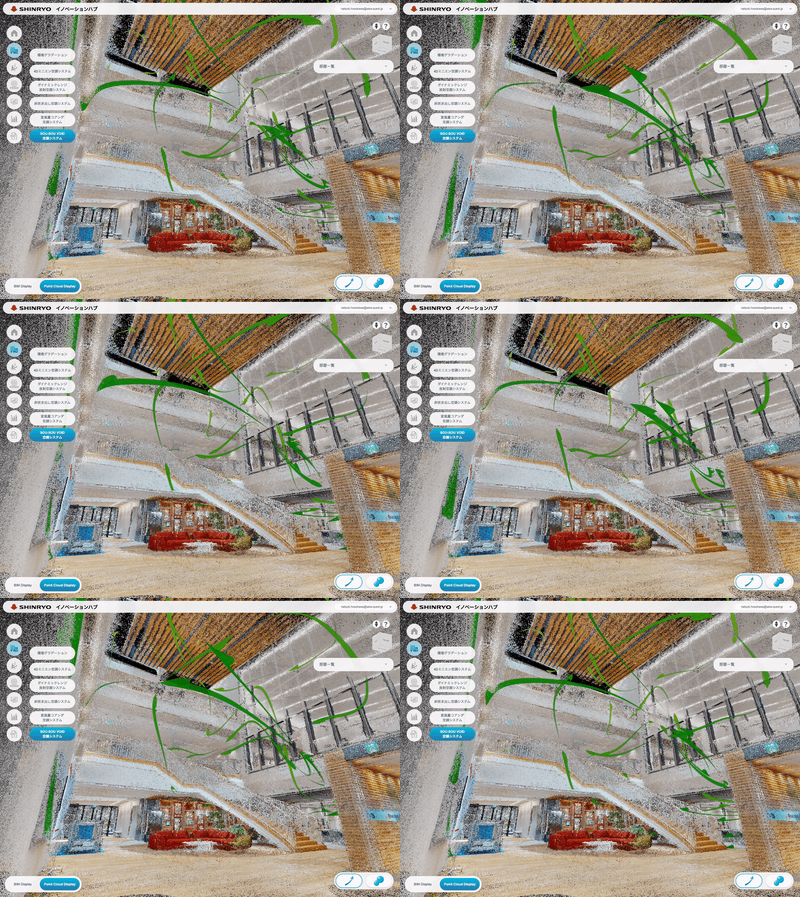
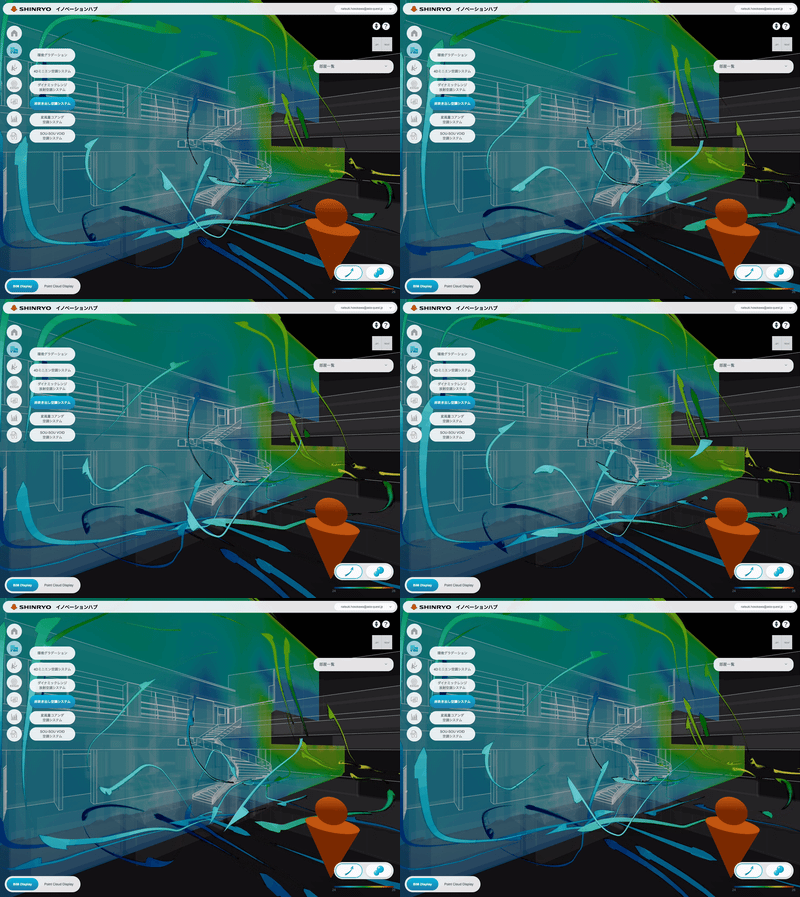
- ― Smart Air Twin: Application Screen ―
Technical Overview
- ① 3D visualization platform using BIM and point cloud data (TypeScript / React)
- ② AI-based CFD prediction model (Python, CNN, Amazon SageMaker)
- ③ Serverless, automated infrastructure on AWS
- ④ Secure operations and monitoring (AWS Systems Manager / Amazon CloudWatch / Amazon Q)
Technologies Adopted: Python for the Backend, TypeScript (React) for the Frontend
The system was developed as a web application, with AWS adopted for the infrastructure. Because Python is the mainstream language for AI development, the backend that interacts with the AI model was also implemented in Python. For the frontend, we adopted TypeScript (React), which AsiaQuest has extensive experience with.
For the 3D display, we built a mechanism that combines BIM data and point cloud data to reproduce the building’s geometry and interior. By overlaying environmental sensor data and fluid simulation results on it, users can grasp the indoor environment at a glance (for how users operate the system, see the System Overview section). CFD analysis is normally performed on an individual-room basis, but a technical hallmark of this system is that it extends the analysis to the entire building, reproducing airflow as a whole, including the influence of outdoor air.
How AI-CFD Works: A CNN Model and Amazon SageMaker
For AI-CFD, we built a CNN model using approximately 2,500 CFD simulation results as training data, and we use Amazon SageMaker for training and model deployment. The technical challenge in this part was to achieve both the accuracy and the speed needed to replace conventional CFD analysis.
Infrastructure on AWS: Serverless and Automated
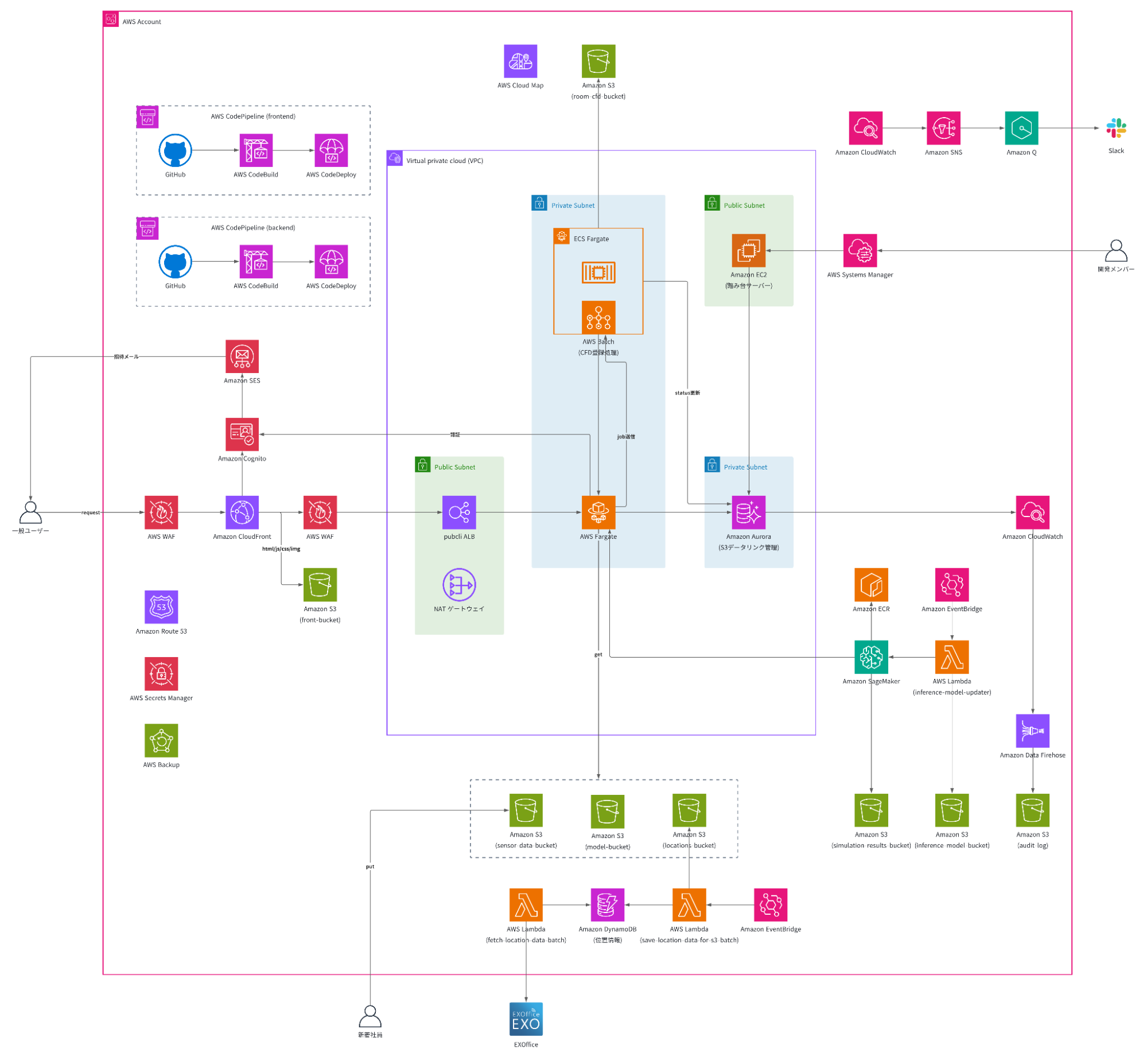
For the infrastructure, we built a serverless configuration using Amazon CloudFront and Amazon S3 for frontend delivery and AWS Fargate for the backend, significantly reducing the burden of server maintenance and operations while ensuring high scalability. AWS Lambda and Amazon EventBridge automate routine processing such as ingesting sensor data, and an automated deployment environment linking GitHub and AWS CodePipeline allows application code updates to be reflected quickly and safely. On the operations side, we established a secure maintenance path with AWS Systems Manager and Amazon EC2, and combined Amazon CloudWatch and Amazon Q with Slack notifications to realize a monitoring environment in which the situation can be grasped in real time.
- System Architecture Diagram
Brand Experience Results and Benefits of Implementation
Dramatically Shorter Analysis Time and Environmental Checks Without Specialized Knowledge
Users can now check the indoor environment in an easy-to-understand visual form without using specialized applications. Analysis time has been reduced to less than 1/200 of that of conventional CFD analysis. Processing that once took several hours is now completed in tens of seconds to a few minutes, so studies can proceed while confirming results on the UI. This also makes it possible to reproduce environmental conditions that are difficult to verify in real space, supporting decision-making for operational improvements and equipment renewal.
Outlook for the future Future Outlook
Improving AI-CFD Prediction Accuracy and Integrating with HVAC Control Systems
The Smart Air Twin developed in this project is being used, as an initial version, to visualize environmental gradients at the Innovation Hub. Going forward, we will first verify and refine the prediction accuracy of AI-CFD, improving the model through repeated comparison with measured values with the aim of returning reliable predictions under a wider range of conditions. In parallel, we will strengthen integration with HVAC control systems. At present, people review the prediction results and use them in operational decisions, but the concept is to automatically feed analysis results back to building systems, evolving toward environmental optimization and automatic control. The goal both companies share is to go beyond visualization and prediction and build a platform that supports HVAC operations balancing comfort and energy efficiency.
At the Innovation Hub, Shinryo has already developed and is operating “CFD-Linked PMV Control,” which uses CFD technology to predict the near-future indoor environment from weather forecasts and sensor information and proactively controls HVAC based on PMV. The automatic control that Smart Air Twin aims for—feeding analysis results back to building systems—is planned to be realized by building on and linking with such existing initiatives.
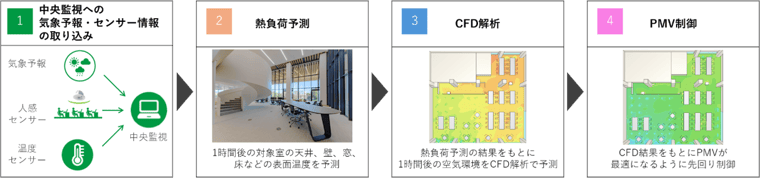
- ― CFD-Linked PMV Control (Reference) ―
Applying the System to HVAC Proposals in the ZEB Era
With HVAC equipment, it is difficult to convey in advance what effects will result after installation. Smart Air Twin has the potential to change how that is explained. Because the system can instantly show in 3D space how the indoor environment changes when HVAC settings are altered, Shinryo can now vary conditions and show results during meetings with customers, conveying the value of the equipment in a tangible way. For customers and members of the public visiting the facility, visualizing the invisible flow of air is also a powerful means of communicating technological capability. Moreover, because AI-CFD has dramatically shortened analysis time, proposals under conditions that previously could not be examined due to time constraints are now possible. Shinryo can respond, with supporting evidence, to the requirement customers have in the ZEB era: achieving both comfort and energy efficiency. Under its Long-Term Vision 2030, “Future Environmental Engineering Company,” Shinryo is promoting construction DX and strengthening its capacity to create new businesses, and the technologies cultivated through this system are expected to become one of the foundations supporting those efforts.
Press Release
Related Press Release[Japanese]
Development of a Digital Twin That Visualizes and Predicts Indoor Environments with AI × CFD — Foundational Technology Looking Ahead to Future HVAC Control —
https://www.asia-quest.jp/information/20260729