Maeda Corporation is a major general contractor handling civil engineering and building construction.
AsiaQuest has provided end-to-end technical support for Maeda's "Blast Pattern Design System," developed for mountain tunnel construction — spanning system design and architecture, algorithm implementation, and cloud infrastructure (AWS) construction. We supported the development of an automated calculation system that integrates three data sources — drilling data, point cloud data, and AI face-evaluation data — contributing to a measurable reduction in overbreak volume.
Background & Purpose
Solving blast variability that causes overbreak and underbreak — the path to an integrated three-data algorithm
In Maeda's mountain tunnel blasting process, responding to changing geological and ground conditions and determining the appropriate charge amount had long relied on the experience and judgment of skilled technicians. However, the construction industry is facing a growing shortage of skilled labor, making labor savings and productivity improvement an urgent priority. Variability in blasting results caused by excess or insufficient charge leads to increased "underbreak" and "overbreak" relative to the planned excavation cross-section, which in turn directly increases cycle time in downstream processes and raises the risk of ground spalling. This created a clear need to automate blast planning based on data. To address this challenge, Maeda brought in AsiaQuest as a technology partner and began development of the system.
Moving away from reliance on skilled individuals and instead automating and improving the precision of blast planning through an algorithm that integrates three types of on-site data was the core challenge of this project.
Role
Designing and implementing a blast automation system that integrates drilling, point cloud, and AI face-evaluation data
Development was carried out by a four-person team that combined the on-site knowledge and technical expertise of Maeda's in-house engineering team with AsiaQuest's system design and cloud implementation capabilities. Roles were divided so that AsiaQuest handled system architecture design and AWS infrastructure implementation while leveraging technology assets Maeda had independently developed, including its "AI Face Evaluation System," with the two teams working in close coordination throughout.
Connecting on-site data with AI and AWS — an integrated architecture that brings blast variability close to zero
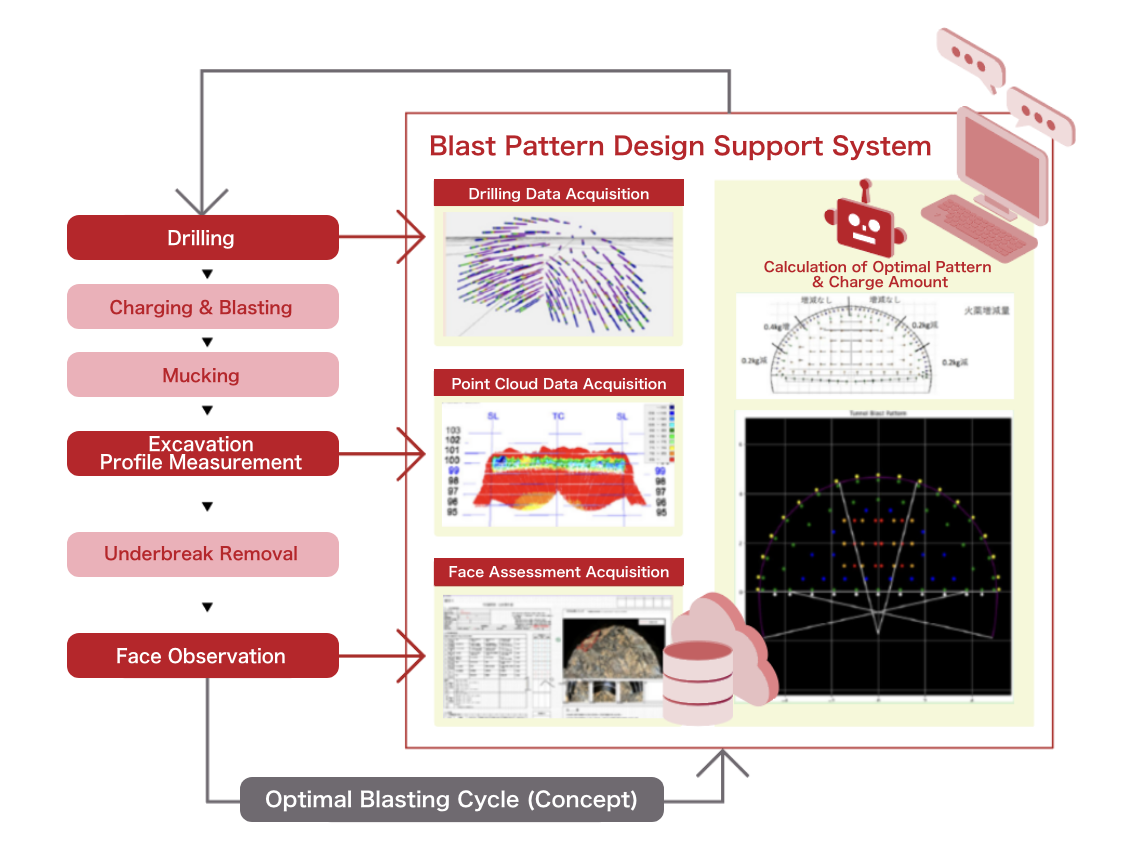
We were responsible for designing and implementing the algorithm that integrates drilling data, point cloud data, and AI face-evaluation data to calculate the blast pattern for each tunnel face. Specifically, we combined the following three approaches.
- ① Use of drilling data
- Calculating rock hardness from 3D data, striking pressure, and rotation speed obtained by fully automated drill jumbos
- ② Use of point cloud data
- Measuring the excavated surface with a 3D scanner to quantitatively capture underbreak and overbreak
- ③ Use of AI face-evaluation data
- Refining the assessment of tunnel face conditions by combining drilling data with AI that judges weathering and cracking from photographs
We also built an architecture that connects data from the fully automated drill jumbos and 3D scanners to the AI system in real time, and adopted AWS as the processing infrastructure — achieving immediate on-site application and scalable operation.
Brand Experience
Reduced overbreak volume — construction quality improvements driven by precise charge control and data utilization
Precise charging and blasting at 100-gram increments successfully reduced overbreak volume. Reduced variability in blasting results has also contributed to shorter cycle times in downstream processes (such as scaling and shotcreting) and improved ground safety. Maeda has given high praise not only for these measurable results but also for the data-driven construction management foundation now in place.
Outlook for the future
Continuing to support construction DX as a technology partner — shaping the future of construction through AI, AWS, and data utilization
We will continue to improve the system further and, by linking it with the development of "automated charging technology," aim to achieve fully automated construction from drilling through to charging. AsiaQuest will remain a technology partner going forward, supporting Maeda's construction DX through data utilization, AI implementation, and cloud infrastructure.
Testimonial
Feedback From The Customer
Realizing this project required not only system design, architecture, algorithm implementation, and cloud infrastructure (AWS) construction, but also a deep understanding of the "ground" being excavated in mountain tunnels. AsiaQuest brings both of these strengths together, with many team members who tackle new technology development with genuine enthusiasm. They also bring a wealth of ideas from many different angles, and we feel they are a partner who thinks through challenges together with us and puts in the effort alongside us.
Going forward, the Blast Pattern Design System will need further refinement in accuracy and continued improvements to make it more user-friendly. We intend to keep working toward improved productivity in mountain tunnel excavation, continuing to rely on AsiaQuest's support along the way.